

Izugbara, Chimaraoke. 2024. “Pandemic masculinity: urban low-income men
and the Covid-19 pandemic in Nigeria”. AFRICA: journal of the International African Institute 94: 655-674.
Abstract:In studies of violence against women and children during the Covid-19 pandemic, as well as in explanations of men’s increased vulnerability to the disease, the concept of ‘toxic masculinity’ regularly surfaces. However, direct research on men’s perspectives on the pandemic’s impact on them as men remains scarce. Drawing on interview data on urban Nigerian men’s lived experiences and narratives of the epidemic in relation to their identities and roles as men, I explore whether toxic masculinity was emblematic of men’s responses to the Covid-19 socio-economic crisis. While I found little evidence of the men’s reliance on toxic masculine practices to maintain their identities as men during the pandemic, their accounts revealed something quite significant: the reconstitution of masculine success in terms of the ability to adjust to the times by discontinuing practices that, while once essential to their identity as men, now threatened their image as capable providers. These adjustments, which frequently involved resorting to practices that would be considered unmanly, were constituted as part of the routine situational pivots that ‘real’ men must make, in keeping with their role as all-weather providers. I conclude with a reflection on how so-called non-heteronormative male performances might still mask gender inequalities and perpetuate certain aspects of patriarchal power.
Résumé: Dans les études sur la violence envers les femmes et les enfants pendant la pandémie de Covid-19, ainsi que dans les explications de la vulnérabilité accrue des hommes à cette maladie, le concept de « masculinité toxique » fait régulièrement surface. Cependant, les études directes sur les perspectives des hommes sur l’impact de la pandémie sur eux en tant qu’hommes restent rares. En s’appuyant sur des données d’entretiens sur les expériences vécues, et sur les récits de Nigérians urbains sur l’épidémie concernant leur identité et leur rôle en tant qu’hommes, l’auteur pose la question de savoir si la masculinité toxique était emblématique des réponses des hommes à la crise socioéconomique de la Covid-19. Bien que rien ou peu ne permette de prouver que ces hommes ont eu recours à des pratiques masculines toxiques pour maintenir leur identité en tant qu’hommes pendant la pandémie, leurs récits ont révélé quelque chose d’assez significatif : la reconstitution du succès masculin en termes de capacité à s’adapter à l’époque en abandonnant des pratiques qui, bien qu’autrefois essentielles à leur identité en tant qu’hommes, menaçaient désormais leur image de soutien de famille capable. Ces ajustements, qui impliquent souvent le recours à des pratiques considérées comme peu viriles, s’inscrivent dans les revirements situationnels habituels que les « vrais » hommes doivent opérer, en adéquation avec leur rôle de soutien de famille en toutes circonstances. L’auteur conclut par une réflexion sur la manière dont les comportements masculins dits non hétéronormatifs peuvent encore masquer les inégalités de genre et perpétuer certains aspects du patriarcat.
Resumo:Em estudos sobre a violência contra mulheres e crianças durante a pandemia de Covid-19, bem como em explicações sobre a maior vulnerabilidade dos homens à doença, o conceito de ‘masculinidade t´oxica’ surge regularmente. No entanto, a investigação direta sobre as perspectivas dos homens relativamente ao impacto da pandemia sobre eles enquanto homens continua a ser escassa. Com base em dados de entrevistas sobre as experiências vividas por homens urbanos nigerianos e narrativas da epidemia em relação às suas identidades e papéis como homens, exploro se a masculinidade t ´oxica foi emblemática das respostas dos homens à crise socioecon´omica da Covid-19. Embora tenha encontrado poucas evidências de que os homens tenham recorrido a práticas masculinas t´oxicas para manterem as suas identidades como homens durante a pandemia, os seus relatos revelaram algo bastante significativo: a reconstituição do sucesso masculino em termos da capacidade de se ajustarem aos tempos, descontinuando práticas que, embora outrora essenciais para a sua identidade como homens, ameaçavam agora a sua imagem como provedores capazes. Estes ajustamentos, que frequentemente envolviam o recurso a práticas que seriam consideradas pouco masculinas, foram constituídos como parte da rotina de mudanças situacionais que os ‘verdadeiros’ homens têm de fazer, de acordo com o seu papel de provedores de tudo. Concluo com uma reflexão sobre a forma como os chamados desempenhos masculinos não heteronormativos podem ainda mascarar desigualdades de género e perpetuar certos aspectos do patriarcado.
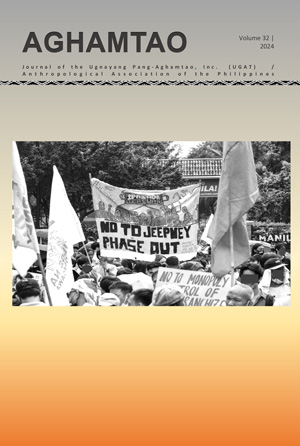
Nishio, Zenta. 2024. “Between Encroachment and Governmentality: Trajectories of Informality in The Jeepney Sector Under Modernization in Metro Manila”. AGHAMTAO 32: 1-22.
Abstract:Informality, a pivotal urban studies notion traversing the Global South, has become a central focus in understanding housing markets, labor relations, political agency, and power dynamics in urban environments. Two research trends within informality are explored here: one highlighting the agency of subordinate groups as encroachers, and the other emphasizing the State’s governmentality, investigating how legal enactments contribute to informality. This paper delves into the concept of informality using the Philippine government’s modernization program of public transportation== specifically the iconic jeepney—and the resultant opposition movement as a case study. The modernization program transforms subordinate groups into “beneficiaries”, challenging their political agency, while the governmentality perspective risks overlooking agency and autonomy.
Jeepneys, historically an informal mode of transportation encroaching on the State, face formalization in the recent modernization efforts, akin to gentrification against slum communities. The “Tunay na Modernisasyon” [‘Real Modernization’] slogan from the March 2023 jeepney strike, post-pandemic, and the extensive social media support it garnered is analysed as rooted in the autonomy of informality. This movement critiques the State’s uniform modernization, and envisions an alternative urbanism.
Linares Sánchez, Malely. 2024. “Mujeres p´urhépecha frente a las violencias machistas: Acuerpar la memoria y defender el territorio”. AIBR Revista de Antropología Iberoamericana 19(3): 483-505.
Resumen:Esta propuesta tiene como objetivo la construcción de una tipología que permita analizar las violencias históricas infringidas hacia las mujeres p´urhépechas en Cherán y cómo estas se vinculan con las disputas presentes en el territorio, especialmente por la apropiación del bosque. Haremos hincapié en las diversas estrategias de lucha y resistencia que ellas han erigido para paliarlas y para defender las distintas formas de vida. Esta construcción analítica se realizó a través de los talleres de cartografías cuerpo-territorio que se llevaron a cabo en diferentes periodos temporales durante los seis años de trabajo de campo que contemplan esta investigación (2016-2022) y de los cuales participaron mujeres de la comunidad en diferentes rangos de edad.
Abstract:The objective of this proposal is to build a typology that allows analyzing the historical violence inflicted on P’urhépecha women in Cherán and how they are linked to the disputes present in the territory, especially over the appropriation of the forest. We will emphasize the various strategies of struggle and resistance that they have erected to alleviate them and to defend the different forms of life. This analytical construction was carried out through the body-territory cartography workshops that were carried out in different time periods during the six years of fieldwork that this research contemplates (2016-2022) and in which women from the community participated. in different age ranges.
Calleja, Raúl Nieto and Julio César Becerra Pozos. 2024. “Hacia una antropología de la noche urbana (Towards an anthropology of the urban night)”. Alteridades 34(68): 11-23.
Resumen:A partir de una perspectiva interpretativa, reflexionamos sobre el carácter dicotómico y predominantemente urbano de la noche en su sentido amplio. Mediante el análisis de la relación entre espacio urbano y performance, proponemos abordar los usos y significados –simbólicos y sociales– de la noche urbana, expresados a través de la experiencia vivida en un espacio y tiempo social cuyos accesos diferenciados, desigualdades e imaginarios particularizan y diversifican las prácticas culturales. Así, aunque la gran diversidad y totalidad de las prácticas nocturnas resulta evidentemente inabarcable, introducimos como herramienta metodológica para el acercamiento y su análisis, una distinción entre dos amplias esferas interrelacionadas, complementarias y con fronteras liminales que nos permiten diferenciar los usos y significados de la noche con énfasis en las prácticas laborales: la noche privada / cotidiana (lo nocturno - noctis) y la noche social que trastoca los márgenes cotidianos (la nocturnidad - noctem).
Abstract:From an interpretative perspective, we reflect on the dichotomous and predominantly urban character of night in its broad sense. Through the analysis of the relationship between urban space and performance, we propose to examine the uses and meanings –both symbolic and social– of urban night, which are expressed through lived experiences in a social space and time characterized by differentiated access, inequalities, and specific imaginaries that particularize and diversify cultural practices. Although the vast diversity and totality of nocturnal practices are evidently unmanageable, we introduce a methodological tool for their approach and analysis: a distinction between two broad, interrelated, complementary spheres with liminal boundaries that allow us to differentiate the uses and meanings of night, with an emphasis on labor practices. These spheres are: the private/everyday night (the nocturnal - noctis) and the social night that disrupts everyday margins (nocturnality - noctem).
Supernant, Kisha. 2024. “Truth before transition: Reimagining anthropology as restorative justice”. American Anthropologist 126(3): 396-407.
von Seggern, Janne and Anita von Poser. 2024. “Re-engaging Foodways: Life-courses of Disconnection and Reconnection with Food, Environment, and Sociality in Hawai‘I”. Anthropological Forum 34(2): 226–248.
Abstract:The article focuses on the centrality (and relationality) of food, environment, and sociality in the efforts of a group of education practitioners and learners on Hawai‘i Island to create a more liveable future alongside and despite global, social, and ecological upheavals. The ethnographic material stems from an engaged anthropological research on environmental knowledge and ‘āina-based education in Hawai‘i in early 2022 and digital anthropological encounters established before and after the onsite phase. Within this article we hope to convey the idea that, while the education practitioners and learners draw from knowledge of an ancient food system and even ‘restore’ parts of it, they do not simply replicate the foodways of the past by implementing them one-to-one. Rather, in their re-engagements of past foodways, people create social transformations and move through transitions in innovative ways in order to navigate through a contemporary world of disconnection and reconnection, continuity and disruption, loss and innovation, impoverishment and empowerment, as well as powerlessness and creativity.
Winter, Cecilia Pérez. 2024. “Turismo rural y territorio: conceptos, estrategias y tensiones desde el Instituto Nacional de Tecnología Agropecuaria (Argentina) (Rural tourism and territory: guidelines, strategies and tensions at INTA (Argentina))”. Antropología Americana 9(17): 67-91.
Resumen: En este artículo nos interesa indagar cómo se implementa el turismo rural en un territorio a partir de la conformación y aplicación de las políticas públicas que lo orientan. En particular, buscamos analizar quiénes y de qué forma participan y qué nociones sobre turismo, ruralidad y territorio se representan. A su vez, dar cuenta de las tensiones que suscitan en estos procesos de diseño e implementación de políticas públicas turísticas. Para ello proponemos como caso empírico al Instituto Nacional de Tecnología Agropecuaria en Argentina. Concluimos que el enfoque territorial rural promovió cambios en la forma de entender y gestionar el turismo rural por dicho organismo logrando construir legitimación a esa modalidad dentro de la institución.
Abstract: This article investigates how rural tourism is implemented in a territory from the conformation and application of the public policies that guide it. In particular, we seek to analyze who and how they participate and what notions about tourism, rurality and territory are represented. Also, we look to examine the tensions that arise in these processes of design and implementation of public tourism policies. For this, we propose as an empirical case the National Institute of Agricultural Technology in Argentina. We conclude that the rural territorial development approach promoted changes in the way of understanding and managing rural tourism by that institution, contributing in constructing and achieving its legitimacy inside INTA.
Cabezas, Luis Puche. 2024. “Amistad, redes de apoyo mutuo y activismos juveniles. Respuestas solidarias a la discriminación (Friendship, mutual support networks, and youth activism. Solidarity responses to discrimination)”. Antropología Experimental 24(16): 221-237.
Resumen: En este artículo se exploran algunas de las respuestas solidarias que, en la infancia y la juventud, se están poniendo en marcha para afrontar la estigmatización y las violencias de carácter transfóbico que tienen lugar particularmente en los contextos escolares, aunque no solo allí. Para ello, se recurre a las voces de niñas, niños y jóvenes que se identifican (o son identificados por sus entornos) como trans y que han desplegado tácticas y estrategias de distinto nivel con el objetivo de protegerse de la hostilidad ambiental e incluso de cuestionar y transformarla de forma organizada. Las narrativas que se presentan proceden de un trabajo de investigación socio-antropológico realizado en España en la última década y dan lugar a un análisis que se organiza del siguiente modo: en primer lugar, se aborda el papel de la amistad y las alianzas informales de apoyo mutuo que se tejen en las escuelas; en segundo lugar, se recorren ciertas experiencias de visibilidad y activismo de tipo presencial; en tercer lugar, se ofrece un análisis crítico de las comunidades virtuales de varones trans. Se concluye el artículo formulando algunos interrogantes y desafíos que estas realidades nos plantean.
Abstract: This article explores some of the responses that, during childhood and youth, are being implemented to confront stigmatization and transphobic violence, particularly in school contexts, although not exclusively limited to them. To do this, we utilize the voices of girls, boys, and young people who identify (or are identified by their environments) as trans and who have deployed tactics and strategies at different levels with the aim of protecting themselves from environmental hostility and even questioning it, transforming it in an organized manner. The narratives presented stem from socio-anthropological research conducted in Spain over the last decade and give rise to an analysis focusing on the following questions: firstly, the role of friendship and informal support alliances that are mutually woven in schools; secondly, the experiences of visibility and in-person activism; thirdly, the virtual communities of young trans individuals. Through these narratives, we observe the significant role of support networks and communities in the processes of resilience and coping with discrimination. The article concludes by raising some questions and challenges posed by these realities.
De la Maza, Francisca and Luis Eugenio Campos. 2024. “Reconocimiento tardío: incidencia en la política indígena de ‘nuevos’ pueblos y territorios indígenas (Late Recognition: Impact of ‘New’ Indigenous Peoples and Territories on Indigenous Policy)”. Antropologías del sur 11(21): 145-166.
Resumen:El artículo aborda las implicancias de la puesta en acción de la política indígena orientada a los pueblos y territorios indígenas que no se consideraron inicialmente en la promulgación de la Ley Indígena N° 19.253 de 1993. A partir de una investigación etnográfica y colaborativa de larga duración, se analiza el proceso de reconocimiento de estos pueblos: en 2006, el pueblo Diaguita; en 2020, el pueblo Chango y en 2023, el pueblo Selk’nam, a lo que se suma el Pueblo Tribal Afrodescendiente en 2019, con la Ley N° 21.151. En particular, se analizan las implicancias de este reconocimiento tardío en la relación entre líderes y organizaciones indígenas y funcionarios en diferentes dimensiones, como los procesos de acreditación, la conformación de comunidades y la implementación de la política indígena. Finalmente, el artículo muestra la relevancia de la perspectiva y la metodología de la etnografía del estado para analizar las múltiples complejidades del contexto, los agentes y la agencia de los involucrados en estas relaciones y las formas de negociación, conflicto y colaboración en este reconocimiento tardío, en contraste con los pueblos y territorios indígenas que fueron incorporados explícitamente en la ley en 1993.
Abstract:The article addresses the implications of the implementation of indigenous policy aimed at indigenous peoples and territories that were not initially considered in the promulgation of Indigenous Law N° 19.253 of 1993. Based on long-term ethnographic and collaborative research, it analyzed the process of recognition of these peoples incorporated into the law; in 2006, the Diaguita people, in 2020 the Chango people and in 2023 the Selk’nam people, also adding the Afro-descendant tribal people in 2019 with Law N° 21.151. In particular, the implications of this late recognition in the relationship between indigenous leaders and organizations and officials are analyzed, in different dimensions such as accreditation processes, the formation of communities and the implementation of indigenous policy. Finally, the article shows the relevance of the perspective and methodology of state ethnography to analyze the multiple complexities of the context, the agents and agency of those involved in these relationships and the forms of negotiation, conflict, and collaboration in this late recognition, in contrast to indigenous peoples and territories that were explicitly incorporated into the law in 1993.

Menin, Laura. 2024. “’Anti-black racism’ as a slavery’s afterlife? Sub-Saharan African migrants in the marginalized neighbourhoods of Rabat”. Anuac: Rivista della Società italiana di antropologia culturale 13(2): 1-23.
Abstract:In the aftermath of the 2011 revolutions and protests across North Africa and the Middle East, Morocco has witnessed unprecedented public debates on “anti-black racism” (in French, le racisme anti-Noir) against sub-Saharan Africans and its connections with the history of slavery. By including in the discussion the voices of sub-Saharan African migrants living in marginalized neighbourhoods of Rabat, this paper complicates any linear causality between historical slavery and current racism. It shows how the history of slavery interweaves with colonial racial legacies and hegemonic whiteness, contemporary EurAfrican border regimes and labour exploitation, which all push vulnerable migrants further onto the margins of society. Highlighting the racialized dimensions of the transcontinental management of migration and the ways blackness is racialized through border(ing), this paper conceives of racism in Morocco as a multi-faceted and historically situated phenomenon that requires careful contextualization along multiple histories and lines of difference.
Roncaglia, Sara. 2024. “‘We are not here to entertain you’. Sambhaji Bhagat’s voice of presence (‘Non siamo qui per intrattenervi’. La voce della presenza di Sambhaji Bhagat)”. Archivio Antropologico Mediterraneo 26(2).
Abstract:Sambhaji Bhagat is the heir of a centuries-old tradition of songs of participation, protest and peace, whose life blood comes from the folklore heritage of Maharashtra. Finding inspiration in such lok shahirs, bards, as Annabhau Sathe and Amar Sheikh, Sambhaji Bhagat is one of the main innovators of the shahir tradition. The article describes, through his words and his songs, the life story of an artist who attempts, with his lyrics, to give voice in Mumbai to the outcast, to those who today most suffer from the processes of marginalization and expulsion.
Riassunto:Sambhaji Bhagat è l’erede di una tradizione secolare di canti di partecipazione, di protesta e di pace, che traggono linfa dal retaggio folclorico del Maharashtra. Traendo ispirazione da lok shahir, bardi, come Annabhau Sathe e Amar Sheikh, egli è uno dei principali innovatori della tradizione degli shahir. L’articolo espone, attraverso le sue parole e i suoi canti, il percorso biografico di un artista che tenta, con le sue liriche, di dar voce agli esclusi, coloro i quali oggi subiscono maggiormente i processi di marginalizzazione e di espulsione urbana.
Hafstein, Valdimar Tr, Jón Þór Pétursson, and Viggó Þór Marteinsson. 2024. “Mother Cultures: Skyr Microbes, Dairy Maids and Super Women”. Ethnologia Europaea 54 (1): 1–21.
Abstract:This article explores long-standing symbiotic relations between women and microbes in Iceland while analysing the transformation of this relationship in the making of the dairy product skyr during the twentieth and twenty-first centuries. In the past, differences in microbial cultures and production methods meant that the taste and texture of skyr varied greatly. Standardisation and technological innovations have steadily impoverished its microbial diversity over the past 120 years. Starting from a historical account of skyr making, we zoom in on skyr in the twenty-first century, a period in which skyr has had an international breakthrough, captured in branding efforts and advertising campaigns produced in this decade for various types of skyr from producers in Iceland, Europe and the United States.
Petit, Facundo. 2024. “Acústica situada: una lectura antropológica de los mapas de ruido de la ciudad de Buenos Aires (1972-2018) (Situated Acoustics: An anthropological reading of noise maps of the City of Buenos Aires (1972-2018))”. Etnografías Contemporáneas 10(18): 8-33.
Resumen:El problema del ruido en las ciudades ha sido atendido históricamente por las ciencias acústicas, con lo cual se ha priorizado el estudio de las cualidades objetivas del sonido y del oído. Como parte de ese proceso, en la actualidad las políticas públicas desconocen las dimensiones sociales, culturales e históricas del ruido. Este artículo rastrea el concepto de ruido que está incorporado en los mapas de ruido de la ciudad de Buenos Aires, cartografías que operan como diagnóstico de la situación sonora urbana y a través de las que se toman medidas para combatir esta problemática. A partir de una investigación etnográfica, se plantea una lectura antropológica de estos productos publicados en 1972, 2005 y 2018, con el objetivo de analizar las formas en que la escucha técnica implicada en los abordajes de la acústica ambiental se consolidó como especialidad y fue legitimada para ordenar, regir y transformar la ciudad y a sus habitantes. Se concluye que el ruido, cuando es reducido a su aspecto acústico, opera como herramienta legal para considerar de igual manera a múltiples manifestaciones sonoras, por lo cual es necesario ampliar su definición para incorporar los aspectos sociales y culturales que lo constituyen.
Abstract:The problem of noise in cities has historically been addressed by acoustic sciences, prioritizing the study of the objective qualities of sound and hearing. As part of this process, current public policies overlook the social, cultural, and historical dimensions of noise. This article traces the concept of noise embedded in the noise maps of the city of Buenos Aires, which operate as a diagnosis of the urban sound situation and guide the implementation of measures to address this issue. Ethnographic research, and anthropological interpretation of these maps published in 1972, 2005, and 2018 analyze how the technical listening involved in environmental acoustics approaches constitutes a specialty and has been legitimized to organize, govern, and transform the city and its inhabitants. The article concludes that when noise is reduced to its acoustic aspect, it operates as a legal tool to consider multiple sound manifestations equally. Therefore, there is a need to broaden its definition to incorporate the social and cultural aspects that constitute it.
Božić-Vrbančić, Senka and Tomislav Oroz. “’Odmetnuto gledište’ ili…? Ideja akademske slobode danas (’Rogue Viewpoints’ or More…? The Idea of Academic Freedom Today)”. 2024. Etnološka tribina : Godišnjak Hrvatskog etnološkog društva (Etnološka tribina : Journal of Croatian Ethnological Society) 54(47): 3-18.
Sažetak:U radu, koji je koncipiran kao poticaj za raspravu, problematizira se pitanje akademske slobode u suvremenom neoliberalnom kontekstu obilježenom nesigurnošću života. Upućujući na povijesno-društvena, politička i institucionalna ishodišta koja su omogućila (re)definiranje ideala akademske slobode, autori propituju razne suvremene procese – od prilagodbe tržištu rada do kontrole osiguranja kvalitete i provjere “korisnosti znanja” – otvarajući pitanja o mogućnosti “odmetnutog gledišta” (Butler 2009), tj. propitivanja ne samo onog što se predstavlja kao legitimno već i samih granica koje omogućavaju bilo kakvo propitivanje, kao i mogućnost alternativnih imaginarija budućnosti sveučilišta.
Abstract:This paper, envisioned as a starting point for a discussion, addresses the issue of academic freedom in the contemporary neoliberal context that has entered every aspect of our lives. Referring to the historical-social, political, and institutional origins that enabled the (re)definition of the ideal of academic freedom, the authors examine various contemporary processes – from adaptations to the labor market to quality control and verification of the “usefulness of knowledge” – raising questions about the possibility of “rogue viewpoints” (Butler 2009). This entails questioning not only what is presented as legitimate in the context of academic freedom today, but also the very boundaries that allow any questioning and critique, as well as the possibility of alternative imaginaries for the future of universities.
Rabie, Kareem. 2024. “Planning, state building, and the days after in Palestine”. Focaal: Journal of Global and Historical Anthropology 98: 71-85.
Abstract:Drawn from ethnographic fieldwork and documentary research, this article examines three shifts in national-scale planning in Palestine. In the period after the Oslo accords, Palestinian planners were tasked with the responsibility to create formal structures of governance and build for a future, eventual state there. Through that process and especially after the second intifada, national planning came to focus almost exclusively on market openness, privatization, and capitalistic development as part of a state and economy building project. Increasingly since 2015, planners have attempted to re-take some kind of formal authority. This article argues that such regimes show how Palestine is increasingly crafted at the state-scale as a node in wider global political economies in order to ostensibly stabilize the political situation, and in ways that have wide consequences for Palestine.
Clarac De Briceño, Jacqueline. 2024. “La violencia venezolana dentro de la violencia mundial: ¿Tenemos perspectivas de solución?” InSURGentes. Revista para las antropologías del sur 8: 187-201.
Tian, Xuya. 2024. “Writing of Business Ethnography: Reflections on Fieldwork and Theory”. International Journal of Business Anthropology 14(1).
Abstract:The writing of business ethnography has expanded from the study of small social units such as factories to the discussion of transnational markets, transnational business networks and global finance in under the context of globalization. A holistic anthropological perspective and use of ethnography research have played important roles in the development of business anthropology. The research tradition and orientation of anthropology not only determine research perspectives and approaches in business ethnography, they also influence the theoretical construction of business anthropology. The study of business ethnography in China provides not only local interpretations of the theory and practice of business anthropology, but also opportunities to reflect on the use of ethnography for such studies.
Chaabani, Hassen. 2024. “Renewal of structural anthropology through a new concept of knowledge origin ‘The dynamic mixed origin’ or ‘The deepest remembering process’”.
International Journal of Modern Anthropology 3(23) : 115 – 140.
Abstract:The first incentive leading to this study is to search for the origin and the nature of what Levis-Strauss meant by fundamental structures and/or hidden rules that contribute to the construction of languages and cultures within the principal idea of structural anthropology. This leads to rethink the process of knowledge origin that is still a matter of controversial debates. I propose the DNA as a physical source of these hidden innate structures. Supported by evidence and substantial arguments derived from the latest scientific findings, this suggestion is developed and formulated into a new concept of the process of knowledge formation that I call ‘The dynamic mixed origin of knowledge’ or ‘The deepest remembering process’. According to it, the formation of knowledge occurs thanks to our mental abilities through a complex dynamic network of reciprocal interconnections involving (1) extrinsic inputs, (2) what is stored in our conscious and/or in our unconscious and (3) genetic factors. Furthermore, I show how this mechanism of knowledge formation represents a particular remembering process deeper than the known remembering ones. Based on this concept, I clarify some issues such as what we call usually intuition, and I regenerate the principal idea of structural anthropology in a modern vision that is not subject to the criticisms directed at the classical vision. According to this modern vision, among other things, it is considered that cultures are based on the same structural foundations emanated from our genome, but each culture wears a different dress reflecting the impact of accumulating extrinsic inputs and historic events that it was exposed to during its formative stages.

鈴木 和歌奈 (Wakana Suzuki). 2024. “フラクタルな巻き込み——ウルシと人間の間に生じる「重要な他者性」(Fractal Involution: Emerging Significant Otherness between Japanese Lacquer Trees and Humans)”. 文化人類学 (Japanese Journal of Cultural Anthropology) 88(2): 215-229.
抄録:本論文の目的は、ウルシと人間の間に「重要な他者性」が生じることを、文化人類学とフェミニズム科学論の理論に依拠しながら描くことである。昨今、人類学ではアメリカやオーストラリアを中心に、人間と多種の絡まり合いを描く「マルチスピーシーズ民族誌」と呼ばれる潮流が広がりつつある。マルチスピーシーズ民族誌は、人新世の議論を受けて「人間と他の種がどう生きるべきか」という倫理的な問いを土台に発展してきた。そのため、マルチスピーシーズ民族誌の書き手は、倫理や正義の問題へ関心を寄せ、それらをどう分析し語るのかということに積極的に取り組んできた。中には、物語性や想像力を重視した実験的な民族誌も試みられ、書き手の倫理的判断や政治的な立場を民族誌に反映させるものも少なくない。その一方で本論文では、ウルシと人間の入り組んだ関係を実際に生じている現象に付随して描き、フェミニズム科学論の概念を援用しながら多層なスケールで多面的かつ微細に描く。そのために、カーラ・ハスタックとナターシャ・マイヤーズの「巻き込み」という概念を参照する。さらにウルシと人間が巻き込まれていく様子を3つのスケールで描き出すために、ブルーノ・ラトゥールの情動論を拡張する。複数のスケールでウルシと人間が互いに巻き込まれていくことを微細に描くことで、人間と他の種をめぐる倫理的課題を探求する1つの手がかりとなることを目指す。
Abstract:This paper explores how “significant otherness” emerges between Japanese lacquer (urushi) trees and humans. For thousands of years, people in Japan have collected the sap of urushi trees for lacquerwarecrafting bowls, furniture, Buddhist statues, and more. Even though urushi is an important material within Japanese culture, the industry is shrinking with cheaper imported lacquer from other parts of Asia. Based on fieldwork in two small villages in Kansai, Japan, I trace how people are trying to revitalize traditional methods of urushi tree cultivation and sap collection. The process must be done with care because touching and breathing in the sap can also be toxic to humans. Drawing on Feminist STS (Science and Technology Studies) scholars, I trace three scales of “fractal involution” between humans and the trees:“satoyama” revitalization movements as the macro scale, caring for trees as the middle scale, and transforming immune systems as the micro scale.
林文玲(Lin, Wen-ling). 2024. “道路的隱或顯與變化中的隘寮群魯森林靈性實踐(The Hidden or Revealed Paths and Changing Forest Spirituality Practices of the Ailiao Rukai)”.
考古人類學刊 (Journal of Archaeology and Anthropology) 101: 1-46.
摘要:
隘寮群魯凱(或稱西魯凱)傳統以來所認定的森林及其範圍,與當代來自林
業管理單位以及學術專業角度之分類有所不同。譬如依建造或更新方式進行
分類的天然林、原始林、次生林、人工林;或根據所有權加以區分的國有林
公有林及私有林。前述科技官僚視點下的各種森林分類,顯示著人類對於森
林的運用、管理、經營或依賴的不同動機、興趣,以及與之呼應的「森林」
構念和含藏的價值信念。與此相對,藉助有形、可見的路徑,或無形、非實
質通道,隘寮群魯凱大霧台區的在地族人,以往可能可以去到或到不了自身
所屬的傳統森林區。能否去到或到達不了,相當程度繫於此處森林之屬性及
其具有的精神靈性。然而,連結該區域之現代道路的構建,帶來路徑網絡的
更迭及重組,加諸當代生態科學治理思維的導入,使得傳統山林時時被納入
現代森林的範疇之內,傳統靈性實踐因此亦產生轉變。由道路本身及其關係
性本體,相當能夠去指認轉變的隘寮群魯凱傳統森林靈性實踐。
Abstract:The forests and their extents traditionally recognized by the Ailiao Rukai (or West Rukai) differ from the classifications used by forestry management agencies and academic professionals. In contemporary forestry, forests are categorized based on their characteristics – such as natural forests (including primary and secondary forests) and artificial forests – or by ownership, such as national, public, and private forests. These classifications reflect technocratic perspectives shaped by distinct motives, interests, and corresponding “forest” concepts and inherent value systems related to forest use, management, governance, or reliance. In contrast, the understanding of forests of the local Ailiao Rukai people in the Wutai area is tied to their ability (both physical and spiritual) to access these spaces via tangible paths or intangible routes. Whether a forest area could be reached depended not only on its physical characteristics but also on its spiritual significance. However, the construction of modern roads connecting the area has brought about the reorganization and transformation of the local path network. This, coupled with the introduction of scientific ecological concept of governance, have progressively integrated the traditional mountain forest areas into the framework of modern forestry. Consequently, traditional spiritual practices associated with these forests have also undergone changes. These roads and their relational ontology can serve as markers of the transformation of traditional forest spiritual practices of the Ailiao Rukai.
Jackson, Jason Baird and Lijun Zhang. 2024. “Basketry and Festival Among the Dong (Kam) People”. Journal of Ethnology and Folkloristics 18(2): 123-151.
Abstract:While fundamental to the practical concerns of everyday life, bamboo baskets also play important roles within festivals staged by the Dong (Kam) people of Southwest China. Drawing upon fieldwork in Sanjiang Dong Autonomous County in the Guangxi Zhuang Autonomous Region and in adjacent Liping County, Guizhou Province, this article will evoke and contextualize some of the ways that bamboo baskets are bought and sold, used and put on display within festivals held in this mountainous corner of China and the Southeast Asian Massif.

Tamuli, Anouska. “Traditional Ecological Knowledge, Ecocentrism and Climate Resilience: A Reflection on the Significance of Worldviews in Climate Change”. Journal of the Indian Anthropological Society 59 (3): 222-239.
Abstract:Traditional Ecological Knowledge or the knowledge systems of the Indigenous peoples and local communities may be translated into lifeways that are climate resilient. Indigenous and local practices related to weather forecasting, resource management, architecture and the use of social capital in times of crisis facilitate sustainable production and consumption, carbon sequestration, biodiversity conservation and disaster management, all of which are of immense importance to climate change adaptation and mitigation. However, it is crucial to note that TEK translated into climate-resilient practices is founded on an ecocentric worldview that ascribes agency and a moral standing to the non-human entities of Nature. In contrast, the lifeways of modern Western society and those built on its model are largely found to have a negative impact on the environment as they result in unsustainable production and consumption, pollution and biodiversity loss. Anthropocentrism which tells about the worldview of modern Western society asserts the centrality of the human species and reduces the rest of Nature to a mere resource that ought to be exploited for meeting human needs. Undoubtedly, worldviews have a bearing on human behaviour. Measures taken by intergovernmental organisations to adapt to and mitigate climate change largely focus on enabling lifestyle changes of the masses that would promote climate resilience and minimize the adverse impact of anthropogenic activities on the environment. That such measures have not been effective enough is confirmed by reports such as the Adaptation Gap Report 2023 by the UNEP and the NDC Synthesis Report 2021 by the UNFCCC. This paper discusses the significance of Indigenous worldviews and practices in the context of climate action and encourages a rethinking and restructuring of the dominant anthropocentric worldview in favour of a more holistic, ecocentric one as embodied by Indigenous peoples and local communities to better facilitate the achievement of sustainable development and help address climate change.
Riyanto, Geger. 2024. “SHARING A MYTHICAL BEING Migrants, autochthonous communities and the reproduction of myth in northern Seram (Indonesia)”. Paideuma 70/71:103–128.
Abstract:This article examines a commonly shared myth in northern Seram (Indonesia) about a half-snake, half-human being called La Ode Wuna. The myth presumably originated in southeast Sulawesi, but the same theme can be found in the myths of numerous communities in central Maluku. The transmission of the La Ode Wuna myth from southeast Sulawesi to Seram has been enabled by continuous mass migration between the two regions. However, it is also constantly shared due to the tendency of local communities in northern Seram to incorporate strangers and to associate them with power. Moreover, the circulating representation of La Ode Wuna is used by southeast Sulawesi in-migrants themselves, who are Butonese, to engage with the Seramese hierarchy. It is shown how a myth can become pervasive due to the recipient communities reconstructing it according to the schematics they are accustomed to.
De Marinis, Natalia. 2024. “La etnografía como praxis afectiva: resonancias del pensamiento de Myriam Jimeno en escenarios de violencia en México (Ethnography as Affective Praxis: Resonances of Myriam Jimeno’s Thought in Contexts of Violence in Mexico)”. Plural, Antropologías desde América Latina y del Caribe 7(13): 28-45.
Resumen:En este artículo reflexiono sobre los aportes teóricos y metodológicos de Myriam Jimeno para el análisis antropológico de la violencia, particularmente a partir de los conceptos de comunidades político-afectivas y comunidades emocionales. A partir de mi experiencia de investigación en México en contextos marcados por la violencia extrema desde la implementación de la llamada “guerra contra el narcotráfico” en 2007, exploro cómo estas nociones permiten comprender las relaciones entre víctimas, sobrevivientes y otras audiencias en procesos de denuncia, búsqueda de justicia y construcción de memoria. La propuesta de Jimeno resulta clave para pensar las emociones como actos relacionales y como parte constitutiva de la acción política, desafiando visiones que reducen a las víctimas a posiciones pasivas y reconociendo la formación de redes solidarias que emergen en torno al sufrimiento compartido.
Abstract:In this article, I reflect on Myriam Jimeno’s theoretical and methodological contributions to the anthropological analysis of violence, particularly through the concepts of politicalaffective communities and emotional communities. Drawing on my research experience in Mexico in contexts marked by extreme violence since the implementation of the so-called “war on drugs” in 2007, I explore how these notions help illuminate the relationships among victims, survivors, and other audiences engaged in processes of denunciation, the pursuit of justice, and the construction of memory. Jimeno’s proposal is crucial for understanding emotions as relational acts and as a constitutive dimension of political action, challenging views that reduce victims to passive positions and recognizing the formation of solidaristic networks that emerge around shared suffering.
Resumo:Neste artigo, reflito sobre as contribuições teóricas e metodológicas de Myriam Jimeno para a análise antropológica da violência, particularmente a partir dos conceitos de comunidades político-afetivas e comunidades emocionais. Com base na minha experiência de pesquisa no México, em contextos marcados pela violência extrema desde a implementação da chamada “guerra contra o narcotráfico” em 2007, exploro como essas noções permitem compreender as relações entre vítimas, sobreviventes e outros públicos envolvidos em processos de denúncia, busca por justiça e construção da memória. A proposta de Jimeno é fundamental para pensar as emoções como atos relacionais e como parte constitutiva da ação política, desafiando visões que reduzem as vítimas a posições passivas e reconhecendo a formação de redes solidárias que emergem em torno do sofrimento compartilhado.
Wolanski, Sandra. 2024. “Valores perros. Procesos y proyectos de desvalorización y (re)valorización entre los/as trabajadores/as caninos de Buenos Aires (Argentina)”. PUBLICAR-En Antropología Y Ciencias Sociales 36: 72-91.
Resumen:Las actividades de los/as trabajadores/as caninos de Buenos Aires se ubican en la intersección de procesos sociales de escala global vinculados tanto a las transformaciones del trabajo en el capitalismo contemporáneo como a las reconfiguraciones en las nociones de familia, persona, y en torno al valor de la vida animal. Éstas se traducen en experiencias concomitantes y contradictorias de desvalorización y valorización de sus actividades. En este artículo exploro estos procesos en un diálogo heterodoxo entre distintas tradiciones antropológicas para conceptualizar la noción de valor. A partir de este diálogo, propongo comprender al proceso de organización gremial de los/as trabajadores/as caninos como un proyecto creativo de (re)valorización en el que se producen no sólo mejoras sustantivas para el trabajo de las personas, sino formas cotidianas, relacionales y concretas de bienestar animal.

Cantar, Nahir Meline, María Luz Endere and Norma Elizabeth Levrand. 2024. “Los museos en Latinoamérica y el Caribe: un panorama de su permeabilidad a las tendencias globales (Museums in Latin America and the Caribbean: An overview of their permeability to global trends).” Relaciones De La Sociedad Argentina De Antropología 49(1), 093.
Resumen:Organizaciones internacionales especializadas debaten permanente sobre la museología. Estas instituciones suelen elaborar recomendaciones que, a pesar de no ser vinculantes, se consideran normas de soft law, ya que influyen en el derecho interno de los países. No obstante, la influencia del soft law dependerá de cuán permeables sean los sistemas jurídico-administrativos. Por ello, en el presente trabajo se propone analizar la permeabilidad de los países de Latinoamérica y el Caribe a las tendencias globales en torno a los museos a partir de la evaluación de cuatro variables que reconstruyen el grado de implementación de las recomendaciones emanadas de organismos internacionales especializados. Se adopta una metodología de semaforización con una escala de valoración de tres niveles que describe el estado de situación de cada país. Los resultados muestran que los países de la región presentan situaciones muy dispares respecto a la situación de sus museos en el sistema nacional.
Abstract:Specialized international organizations discuss museology on an ongoing basis. These institutions usually develop various recommendations that, despite not binding, are considered soft law norms since they influence the generation or modification of the internal law of the countries. However, the influence of these soft law norms will depend on how permeable the legal-administrative systems are. For this reason, this paper proposes to analyze the permeability of the countries of Latin America and The Caribbean to global trends regarding museums based on the evaluation of four variables that reconstruct the degree of implementation of the recommendations issued by specialized international organizations. A traffic light methodology is adopted with a three-level assessment scale that describes the status of each country. The results show that the region's countries present very different situations regarding the situation of their museums in the national system.
Batkis, Juio. 2024. “¿Y ellos de dónde vienen? Trayectorias de la juventud neorrural del MoCaSE-VC (Where Do They Come From? Trajectories of Neo-rural Youth in MoCaSE-VC)”. Revista de la Escuela de Antropología 34.
Resumen:En la producción académica se ha entendido la migración ciudad-campo, o neorruralismo, como un proceso protagonizado casi de manera exclusiva por sectores medios y altos que revalorizan lo rural como espacio turístico y residencial, en oposición a una ciudad considerada cada vez más como caótica, impersonal y/o insegura. Sin embargo, en este trabajo me interesa destacar aquellos casos de migración ciudad-campo donde los y las protagonistas son jóvenes de sectores populares urbanos que construyen un proyecto de vida en territorios rurales. En particular destaco las experiencias que han sido impulsadas por el Movimiento Campesino de Santiago del Estero - Vía Campesina (MoCaSE-VC) a partir de la constitución de la Universidad Campesina (UNICAM) de Ojo de agua, comunidad con más de 60 habitantes provenientes de diferentes pueblos y ciudades del país. Me interesa indagar en las prácticas cotidianas de estos jóvenes provenientes de “barrios populares” poniendo especial atención a los modos en los cuales entrelazan sus trayectorias de vida con los proyectos político-organizativos en defensa del territorio que lleva adelante el MoCaSE-VC. El objetivo de este trabajo es plantear posibles líneas de investigación reconociendo el estado actual de la cuestión. Así, propongo tres claves de análisis como punto de partida para indagar en la “vuelta al campo” que la juventud está llevando adelante en los espacios rurales santiagueños.
Resumo:Na literatura acadêmica, a migração cidade-campo, ou neo-ruralismo, tem sido entendida como um processo realizado quase exclusivamente pelas classes média e alta que revalorizam o rural como espaço turístico e residencial, em oposição a uma cidade vista como caótica, impessoal e/ou insegura. No entanto, neste artigo, estou interessado em destacar os casos de migração cidade-campo em que os protagonistas são jovens de setores urbanos populares que constroem um projeto de vida em territórios rurais. Em particular, destaco as experiências que foram promovidas pelo Movimiento Campesino de Santiago del Estero - Via Campesina (MoCaSE-VC) por meio da criação da Universidad Campesina (UNICAM) de Ojo de Agua, uma comunidade com mais de 60 habitantes de diferentes cidades do país. Estou interessado em pesquisar as práticas cotidianas desses jovens de “bairros populares”, atendendo especialmente os modos em que eles entrelaçam suas trajetórias de vida com os projetos político-organizativos de defesa do território realizados pelo MoCaSE-VC. O objetivo deste artigo é propor possíveis linhas de pesquisa, reconhecendo o estado atual da questão. Assim, proponho três pontos-chave de análise como ponto de partida para investigar o “retorno ao campo” que os jovens estão realizando nas áreas rurais de Santiago del Estero.
Abstract:In academic production, city-to-country migration, or neo-ruralism, has been understood as a process mainly led by middle and upper-class sectors that revalue the rural as a tourist and residential space, in opposition to a city considered increasingly chaotic, impersonal, and/or unsafe. However, this work aims to highlight cases of city-to-country migration where the protagonists are young people from urban popular sectors who build a life project in rural territories. In particular, I emphasize experiences that have been driven by the Peasant Movement of Santiago del Estero - Via Campesina (MoCaSE-VC) since the establishment of the Peasant University (UNICAM) in Ojo de Agua, a community with more than 60 inhabitants from different towns and cities of the country. I am interested in investigating the daily practices of these young people from "popular neighborhoods," paying special attention to the ways in which they intertwine their life trajectories with the political-organizational projects in defense of the territory carried out by MoCaSE-VC. The aim of this paper is to propose possible lines of research recognizing the current state of the issue. Thus, I propose three keys of analysis as a starting point for investigating the "return to the countryside" that youth are carrying out in rural areas of Santiago del Estero.
Ollier, Agustina. 2024. “Entre indígenas, cautivas y la república: representaciones de las mujeres en la prensa satírica argentina del siglo XIX”. Revista Kula 28: 67-82.
Resumen:En este artículo propongo un análisis sobre los procesos de organización colectiva de las mujeres vendedoras de la Rama de Trabajadores y Trabajadoras del Espacio Público del Movimiento UTEP-Evita en el marco de un proceso de reivindicación de derechos más amplio como es la Confederación de Trabajadores de la Economía Popular (CTEP) -hoy UTEP. El trabajo de campo se desarrolló en el Área Metropolitana de Buenos Aires (AMBA), entre 2022 y 2024. Sostengo que las integrantes del espacio de mujeres en el transcurrir y hacer del mismo, generan un proceso de politización del género y de disputa por sus tiempos, que habilita una problematización colectiva sobre sus prácticas y su lugar en la sociedad, permitiéndoles destinar momentos y tiempos exclusivos para ellas mismas, para su formación, para la construcción de vínculos, y para la organización colectiva como mujeres de la economía popular.
de Souza, Gabriel. 2024. “Ir y volver a Cabo Polonio y naufragar en el pasado”. Revista Trama de la Asociación Uruguaya de Antropología Social y Cultural 1(14): 19-35.
Resumen:Este artículo invita a reflexionar sobre al gunas formas de viajar, concebir, producir sujetos y lugares provocados por despla zamientos a la costa asociados a la situa ción generada por la pandemia COVID 19. Los desplazamientos turísticos y las experiencias de segunda residencia están transformando los destinos de nuestra costa en pueblos y ciudades, como así también dando un nuevo sentido a las for mas de habitar y crear territorios de perte nencia, especialmente para turistas urba nos convertidos en migrantes temporales y/o nuevos residentes. La pandemia no solo ha impactado directamente en la sa lud y la economía, sino que también ha consagrado socialmente el valor de los espacios al aire libre, de encuentro y so ciabilidad y ha puesto de manifiesto algu nas problemáticas de la degradación de la vida urbana que se han vuelto recursivas en eventos tales como la crisis del agua. Sin embargo, esta migración de sectores medios y altos hacia estas áreas también está causando nuevos ciclos de moderni zación urbana, degradación ambiental, in flación de precios, gentrificación, especu lación y mercantilización de los espacios costeros. Mientras parece acabarse la gracia de su naturalidad, algunas áreas protegidas costeras como Cabo Polonio siguen siendo faro para iluminar, ser refu gio de alternativas y condensar en el es pacio tiempos de náufragos, loberos, pes cadores, migrantes y turistas urbanos.
Abstract:Este artículo invita a reflexionar sobre al gunas formas de viajar, concebir, producir sujetos y lugares provocados por despla zamientos a la costa asociados a la situa ción generada por la pandemia COVID 19. Los desplazamientos turísticos y las experiencias de segunda residencia están transformando los destinos de nuestra costa en pueblos y ciudades, como así también dando un nuevo sentido a las for mas de habitar y crear territorios de perte nencia, especialmente para turistas urba nos convertidos en migrantes temporales y/o nuevos residentes. La pandemia no solo ha impactado directamente en la sa lud y la economía, sino que también ha consagrado socialmente el valor de los espacios al aire libre, de encuentro y so ciabilidad y ha puesto de manifiesto algu nas problemáticas de la degradación de la vida urbana que se han vuelto recursivas en eventos tales como la crisis del agua. Sin embargo, esta migración de sectores medios y altos hacia estas áreas también está causando nuevos ciclos de moderni zación urbana, degradación ambiental, in flación de precios, gentrificación, especu lación y mercantilización de los espacios costeros. Mientras parece acabarse la gracia de su naturalidad, algunas áreas protegidas costeras como Cabo Polonio siguen siendo faro para iluminar, ser refu gio de alternativas y condensar en el es pacio tiempos de náufragos, loberos, pes cadores, migrantes y turistas urbanos.
Berisso, Laura. 2024. “Patrimonios que hacen política Producción de fronteras nosotros-otros y megaminería en una localidad de la patagonia sur (Heritage that makes politics Production of us-other boundaries and megamining in a town in southern Patagonia)”. RUNA, archivo para las ciencias del hombre 45(2): 157-174.
Resumen:El objetivo del presente artículo consiste en reflexionar sobre la configuración del patrimonio como dispositivo por el cual se construyen las identidades como diferencia. Particularmente, exploro los modos en que el patrimonio “hace política” al ser movilizado en la producción oficial de fronteras nosotros/otros. Recuperando datos etnográficos provenientes de la investigación antropológica realizada en una localidad minera de la Patagonia sur argentina, analizo cómo un sitio arqueológico se construye desde políticas gubernamentales como patrimonio identitario local. Argumento que ello posibilita a las elites y agencias de gobierno locales generar un sentido particular de pertenencia que, a su vez, apuntala la construcción de “alteridades ausentes” en relación con los pueblos originarios y de “alteridades amenazantes” en relación con los migrantes que llegan para emplearse en la actividad megaminera.
Resumo:O objetivo deste artigo é refletir sobre a configuração do patrimônio como dispositivo pelo qual as identidades são construídas como diferença. Particularmente, exploro as formas pelas quais “faz política” ao ser mobilizado na produção oficial de nós/outras fronteiras. Recuperando dados etnográficos de pesquisas antropológicas realizadas em uma cidade mineira no sul da Patagônia, Argentina, analiso como um sítio arqueológico é construído a partir de políticas governamentais como patrimônio identitário local. Argumento que isto permite que as elites e as agências governamentais locais gerem um sentimento particular de pertencimento que, por sua vez, sustenta a construção de “alteridades ausentes” em relação aos povos nativos, e de “alteridades ameaçadoras” em relação aos migrantes que chegam para ser. empregados na atividade de megamineração.
Abstract:The objective of this article is to reflect on the configuration of heritage as a device through which identities are constructed as differences. In particular, I explore the ways in which it “does politics” by being mobilized in the official production of us/other borders. Recovering ethnographic data from anthropological research carried out in a mining town in southern Argentine Patagonia, I analyze how an archaeological site is built from government policies as a local identity heritage. I argue that this makes it possible for local elites and government agencies to generate a particular sense of belonging that, in turn, underpins the construction of “absent” alterities in relation to the indigenous peoples, and “threatening” in relation to the migrants who arrive to be used in mining activity.

Vacas-Oleas, Sebastián. 2024. “Reading the Future of an Amazonian Mine”. Sapiens.
Abstract:This article examines how Shuar people in southeastern Ecuador use visionary knowledge from hallucinogenic plants such as maikiúa and natem to navigate the threats of industrial mining. Centered on Katán, a Shuar mine worker seeking to organize labor unions at the Mirador copper-gold mine, the article shows how shamanic knowledge can provide courage, certainty, and a sense of agency. While Shuar communities are divided over mining, the article argues that visionary practices inform both anti-mining resistance and efforts to improve labor conditions from within the mining system, helping Shuar people confront exploitation, environmental harm, and threats to territorial autonomy.
Resumen:Este artículo examina cómo el pueblo Shuar del sureste de Ecuador usa el conocimiento visionario obtenido de plantas alucinógenas como la maikiúa y el natem para enfrentar las amenazas de la minería industrial. Centrado en Katán, un trabajador Shuar de la mina que busca organizar sindicatos en la mina de cobre y oro Mirador, el artículo muestra cómo el conocimiento chamánico puede brindar valor, certeza y un sentido de agencia. Aunque las comunidades Shuar están divididas respecto a la minería, el artículo sostiene que las prácticas visionarias orientan tanto la resistencia contra la minería como los esfuerzos por mejorar las condiciones laborales desde dentro del sistema minero, ayudando al pueblo Shuar a enfrentar la explotación, el daño ambiental y las amenazas a su autonomía territorial.

Longmuir, Katriona, Julie Park, Ruth Fitzgerald, Michael Legge and Cris Shore. 2024. “Hope: Valuing lives and persons with degenerative conditions — Duchenne muscular dystrophy”. Sites: a Journal of Social Anthropology and Cultural Studies 20(1): 1-26.
Abstract:Duchenne muscular dystrophy (DMD) is a life-shortening genetic condition involving progressive muscular wasting for which there is no hope of recovery at present. The lives of people with DMD, cherished by their families, are systematically marginalised and undervalued by healthcare bureaucracies while enrolment in clinical trials of new treatments offers possibilities of longer-term biomedical solutions. How is hope preserved under such circumstances and what activities can promote a full and meaningful life for those with DMD Ethnographic research within the DMD community in Aotearoa New Zealand provided a basis for addressing these questions and for understanding different concepts of hope and social suffering, the value of life in DMD and disability studies, and how these are shaped by regimes of governmentality.
Sankelo, Juhanna, and Paulino Jijiyo. "Rural Murle Age-Set Men Tackling Elites in South Sudan." Suomen Antropologi: Journal of the Finnish Anthropological Society 48, no. 3 (2024): 50-72.
Abstract:The Murle age system is often presented in a negative light in the South Sudan conflict reporting, which links age-set activities to communal violence, cattle rustling, and the abduction of women and children. Such assessments by outsiders overlook the positive effects of age-sets on interethnic relations in rural areas, where young people follow the Murle tradition and navigate the complex influence networks of Murle society. We focus on pastoral Murle youth in Pibor born in the 1980s and 1990s—that is, the laŋo age-set. By drawing on in-depth life-story interviews, this article studies how Murle laŋo masculinity is constructed, embodied, and negotiated. The analysis of our ethnographic data exemplifies how early childhood emotional bonds with caregivers, conflicts, and marginalisation impact the life trajectory of one Murle man. Our results show the connectedness of political orientation, tradition, and masculinity to intergenerational conflict and competition for political and societal power in Murle society. The study increases our understanding of Murle laŋo men’s survival strategies. Specifically, it shows that these rural marginalised Murle youth build alliances beyond kinship and ethnic ties, defend land, advance the goal of peace with neighbours, volunteer for unpaid community work to fight idleness, and act as a counter force to prevent manipulation by political and military leaders.
Zɔɔz:Zɔɔz nici ɔp bayiz ci ɔl o maac een murle abaak Murla, ki gɔl ci bayizo, ki gɔl ci ganonto been culanɛ ci kobɛkɛ ɔl kaal. Gi ci titiny bayize ceen murlen nɛɛn, buluwa kibeen kerenɛ ogi o murle gɔɔn anya bayiz o gɛɛr gɔɔn aruwɔn ɔl, ma kɔran tiin moda ma kagaman ŋai ki dɔɔl ci modo. Mazin liŋliŋɔnti nici aŋamnek kaal o abon agɔɔn bulowa o abaak murla loce o ɔl o kolik een junup ŋawo azɔɔzi kaal o bayiz uneŋ murlo. Ma golowa ci kaŋamneka kalyanit o bayiz o een murlen, ayelza rɔŋrɔŋanɔnɛt ci arɔrɔŋanɔn nigi ki, gɔɔl ci adiŋdiŋani Jowanɛ o adilyai, gɔl ci siaso, ki kɛranɛ, ki kaal ci akati ŋayetin ki jorɛnɛɛn zɛɛ been ŋɛrɔn ci aŋɛrɔɔn alata o murlo aŋɛrɛ sias giye ci arɔɔŋi rum o. Bayizi ween aturuwen aroŋnyi, ayelzai bule o kazi lango, agamta nigi bayiz ci aromɛn niŋgi dook kodoye, ma arican ganɔɔn ma buk ɔp calaŋ aŋɛɛr nɔgɔ siasa karabɔŋ een zɔɔz ci takirzetu.
Blouin, Philippe. 2024. “Stirring the Ashes: How Mohawk Mothers Fight Against Representation”. Swiss Journal of Sociocultural Anthropology 30 (1): 81–99.
Abstract:
Abstract: This article draws on participant observation in a legal battle at the Quebec Superior Court in 2022, where the Kanien’kehá:ka Kahnistensera (Mohawk Mothers) sought an injunction to halt excavation work around a hospital where Indigenous victims of medical experiments were allegedly buried. In response to a motion from the government of Quebec, the Mohawk Mothers refused to use a lawyer who would obey colonial law, arguing that it was their traditional duty as caretakers of the territory to speak for themselves and for their community without legal representation. This article examines their fight for self-determination through their specific understanding of the relationship between individual autonomy and social responsibility, notably by way of the Kanien’kehá:ka’s use of a single word to denote assemblies, fires, and families: Kahwá:tsire’. To reach a consensus, when it seems that everyone has come to an agreement, the Kanien’kehá:ka council must “stir the ashes” and ask everyone who has not spoken yet to voice their opinion and bring their unique perspective in the balance. As a result of this method, the author suggests that the Kanien’kehá:ka simultaneously take on the roles of legislators, executors, and judges all at once.
鄭肇祺 (Cheng, Eric Siu-kei). 2024. "自然資源管理與大學社會責任實踐計畫的相遇:臺灣東海岸的虱目魚苗、瓊麻、廟宇與人的關係 (Natural Resource Management Encountering A University Social Responsibility Project: The Relationships Between Milkfish Fry, Sisal, Temples, and Human Beings along Taiwan’s East Coast)". 臺灣人類學刊(Taiwan Journal of Anthropology) 22(1): 35-72.
摘要:本文從教師經驗出發探討文化和自然資源管理與大學社會實踐計畫的相 遇及後果。加入臺東大學後,筆者成為大學社會責任實踐計畫(USR計畫) 的協同主持人,參與這個結合戶外運動、數位媒體及深度觀光組成的社會實 踐計畫,並導入文化資產議題,與學生共同探索臺東地區的文化資產及休閒 遊程之設計。筆者以二十世紀中期虱目魚苗的捕撈地點―杉原灣―作為教學 場域。時而勢易,昔日漁民從西部移動到此尋找生計的海灣,部份已被核定 為富山護漁區。筆者以文化資產及觀光設計為出發點,討論社會實踐計畫如 何影響筆者在教學上對自然和文化資源的選擇、構成、轉化與延伸。藉著 整理於2019-2021年之間對USR計畫的執行經驗,以及課程設計、調整及反 思,筆者討論以下議題:一、以虱目魚的生活史及富山護漁區為例,產業、 人、動物的互動關係形成海岸資源管理的軌跡(trajectory)和可轉化的觀 光資源;二、人類學背景的筆者在公路上和產業鏈內的移動與非人類系學生 共同利用圖像化的方式紀錄臺灣漁民的日常生活及東海岸產業、廟宇歷史;三、於臺灣學界愈見重視教學實踐的情況下,人類學背景之教師可適應並發揮田野工作的能力,應用於跨學科的社會實踐計畫。藉此,筆者檢視把人與動物、植物互動關係的圖像化作為文化多樣性、永續觀光及地方歷史教材的工作貢獻程度。
Abstract:This paper examines how cultural and natural resource management encountered university-engaged social practices, and the subsequent consequences, based on a university teacher’s experiences. I joined National Taitung University as a faculty member in 2019. Since then, I have become a project sub-investigator of the University Social Responsibility Project (USR), sponsored by the Ministry of Education, to design courses and collaborate with local residents and practitioners, including fishers, environmentalists, and temple leaders, to facilitate regional responsible tourism. The project tasks comprise outdoors activities, digital marketing, and in-depth tourism. I collaborate with students to explore cultural heritage preservation and to enrich designs and itineraries of sustainable tourism at the regional level. This paper sheds light on our experiences in this project and analyzes how and why anthropological knowledge, skills, and reflections can be applied to sustainable tourism education and associated regional resource management.
Faculty members from different departments and disciplines, including outdoor activities, media production, and cultural resource management, carry out the abovementioned USR project to facilitate cross-disciplinary collaborations as well as teaching and learning outcomes. The project has extended its influence from one community to other regions, including Sugihara Beach, a former milkfish fingerling catching area and now a coastal marine resource protection area, where I design teaching and learnings activities. This article focuses on the cultural heritage record and tourism design to discuss how the USR and anthropological training affect my selection, reconstruction, conversion and extension of cultural and natural resources in teaching. This paper presents my project implementation experiences between 2019 and 2021 to reflect on my course design and modification in order to investigate the following issues. First, how the changing industrial sectors, the milkfish’s life cycle, and human activities (including land development, folk religion, environmental protection, etc.) interact with each other. Such interactions affect the trajectory of coastal resource management along the Sugihara Beach. Second, my anthropological experiences have influenced my strategies for teaching students who are not anthropology majors to record Taiwanese fishers’ daily life experiences, life stories, and perspectives, as well as the history of local sectors and a temple on the east coast. My courses associated with the USR project have become teaching material collection processes and subsequently changed the ways that I convert life histories into cultural resources aimed at in-depth tourism. Last but not least, anthropologists can apply their ethnographic skills and knowledge to multidisciplinary social practices.
Reviewing both the team and individual work in this project, I share the experiences of the USR strategy and evaluate my own experiences and contribution of visualizing human-animal-plant interactions for teaching cultural diversity, sustainable tourism, and local history. Teachers trained in anthropology co-learn with students from local residents with through an ethnographic approach, and the outcomes can be more diverse than a textual ethnographic account. The visualization of cultural and natural resources can attract more non-anthropology-major students to learn and adopt anthropological skills and thinking. Teachers need to consider how to prevent local politics from disrupting teaching process. They can introduce concepts, practices, and local perspectives to develop more localized teaching materials. Such materials can become tools that students can use to develop their non-academic career skills and knowledge. They can also encourage students to use anthropological knowledge in their future careers.
Alarcon, Daniela Fernandes, Glicéria Jesus da Silva, Jéssica Silva de Quadros and Sthefany Ferreira da Silva. 2024. “Resisting Bolsonaro: The Mobilization of the Tupinambá of Serra do Padeiro to Defend Their Territory and Collective Projects”. Vibrant: Virtual Brazilian Anthropology 21.
Abstract:The main objective of this article is to examine the political mobilization of the Tupinambá of Serra do Padeiro (southern Bahia) during the presidential term of Jair Messias Bolsonaro (2019-2022). In a context of grave rights violations, the Indigenous movement emerged as one of the main forces of resistance to Bolsonarismo. Through an analysis of the strategies developed in Serra do Padeiro, we take five key episodes as starting points: the uncovering of a targeted plan to exterminate Indigenous leaders, an attempt to build a resort on Tupinambá territory, setbacks in the demarcation procedures for the Tupinambá de Olivença Indigenous Territory, mobilization of repressive forces against protective measures adopted in Serra do Padeiro during the Covid-19 pandemic, and the granting of an eviction order against the Tupinambá. Through a detailed examination of a specific case, we seek to contribute to the production on forms of collective action carried out by Indigenous peoples.
Resumo:Examinar a mobilização dos Tupinambá of Serra do Padeiro (sul da Bahia) durante o mandato presidencial de Jair Messias Bolsonaro (2019-2022) é o principal objetivo deste artigo. Em um contexto de graves violações de direitos, o movimento indígena emergiu como uma das principais forças de resistência ao bolsonarismo. Aqui, partimos de cinco episódios-chave para analisar as estratégias desenvolvidas na Serra do Padeiro: o desvelamento de um plano para assassinar lideranças indígenas, a tentativa de construção de um resort no território tupinambá, retrocessos no procedimento de demarcação da Terra Indígena Tupinambá de Olivença, a mobilização de forças repressivas contra medidas protetivas adotadas na Serra do Padeiro face a pandemia de Covid-19 e a concessão de uma liminar em ação de reintegração de posse contra os Tupinambá. Por meio da consideração detida de um caso específico, esperamos contribuir com a produção analítica sobre formas de ação coletiva levadas a cabo por povos indígenas.